

And then the ball came flying my way…
About “YORIDOKORO – Silent Anchor” by Megumi Eda, in cooperation with Reiko Yamada
4-6 June 2026
By Lea Pischke
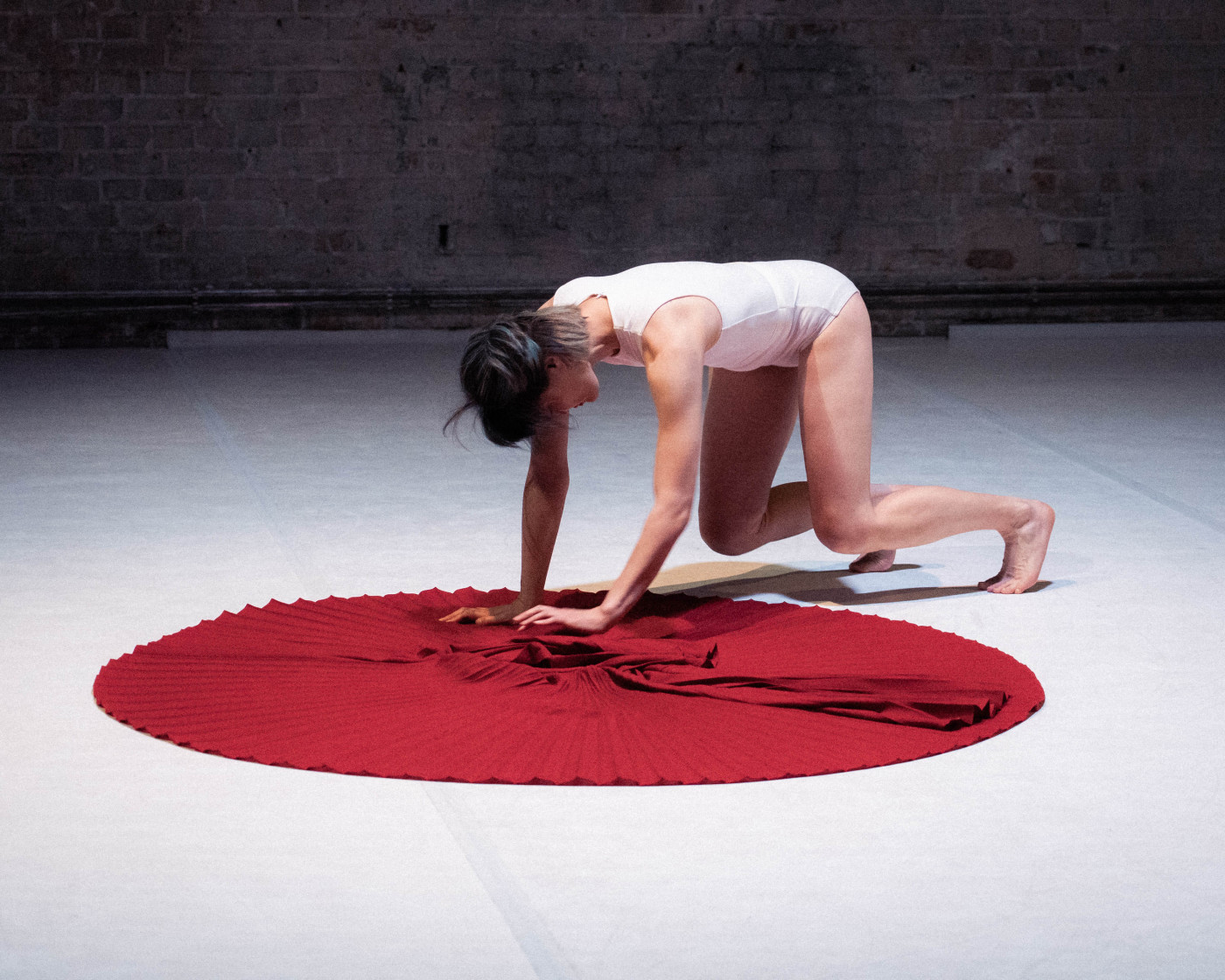
A gracefully placed body draped onto a blood-red round piece of fabric in the centre of the stage.
It is the body of a classically trained dancer: slender, articulate, in a tight fighting costume, the skin shimmering in the dim stage light. A dreamy sound trickles out of the speakers, interlaced with sounds that seem to be constantly descending, lending the stage atmosphere an overall eerie feel. This eeriness is equally transported by the performer’s dancing: a “préparation” position from classical ballet turns into a chimeric monster with open round legs. A “port de bras”, usually carried out with elegance, bears claw-like hands, casting a shadow on the stage’s back wall. Something is off.
With “YORIDOKORO – Silent Anchor” choreographer and dancer Megumi Eda opens the door to her inner sphere, her mental realm. She seems to be negotiating something that causes her distress. We witness snippets of shifting movement aesthetics hovering in a grey zone between contemporary ballet and team-sports, we see her running backwards, clad in a jersey, shorts and trainers, all the while crunching a ball in her hands. We see her being taught how to serve and pass a volleyball via a video conference with her friend and artistic partner Reiko Yamada, we see her repeat a short ballet combination over and over again, always struggling to keep her balance at its end. And then Yamada who – until then – has been sitting at a desk on the outer edge of the stage, quietly manipulating the soundtrack with her laptop, gets up to unravel and hang a volleyball net, thus separating the stage from the audience.
The match is on.
Megumi Eda serves a ball. It comes flying over the net with speed. Screams erupt. The public needs some time to grasp that this is really happening: the performer is indeed throwing a ball at the people sitting on the tribune. Some duck in fear, others take on the challenge and play the ball back to the performer. There’s excitement in the atmosphere, with the thrill of risk mixed in.
Why risk?
Not only is Eda playing a ball to the audience, repeatedly. She is also playing that ball badly. So badly, in fact, that the ball nearly hits Yamada’s laptop in one round, barely avoiding the videographer’s camera and tripod in another, getting dangerously close to the theatre lights hanging above the stage, as the ball is often taking an unpredictable direction. Megumi Eda, the experienced dancer who has been honing her stage craft over decades, has become a potential safety threat for the audience.
We, the people seated on the tribune, slowly begin to understand, viscerally, to what extend Megumi Eda is an amateur. With every ill-directed pass, pointed towards the left, ending up in the upper ranks of the right, we understand how far away she is from her safe space: the world of classical and contemporary dance.
Towards the end of the show, Reiko Yamada steps onto the stage a second time, playing the volleyball against the theatre’s walls. She raises her hand with practised ease to play a serve, handling every rebound effortlessly, always confident that the ball will hit the wall exactly where she expects it to hit. The piece concludes with a change in costume: Megumi Eda dons her volleyball gear for an undulating wide-sleeved dress – the blood-red fabric of the beginning – to move across stage featherlike, visibly content to have left the world of volleyball behind her.
The Unmastered Skill
Volleyball is a highly popular sport in Japan and a staple in every Japanese school and university.
Created by a physical educator in the late 19th century in the United States, the game quickly caught on especially in Eastern Europe and East Asia and was introduced as an Olympic sport in 1964 on the occasion of the Tokyo Games where the Japan’s women’s team famously won gold. Japanese volleyball teams have often been admired for their precision, court awareness and flawless team work. As a Japanese citizen growing up in Japan, Megumi Eda also had to play volleyball at school. She dread having to handle the ball and would have very much preferred dancing instead. This is what we learn later in the post-show artist talk.
The program text reads: “This work explores the Japanese concept of kokoro no yoridokoro – a place of grounding or return”. While doing so, the work also explores its exact opposite: the uncanny valley, the discomfort zone that no-one wants to return to. With her demonstration of “endearing uselessness”, Eda shows us where her “silent anchor” is – and where it isn’t.
A Word on Virtuosity
For Eda the safe space is in practising and performing dance; the safety is located both on stage and within her own virtuosic body. There is a peculiar double-sidedness to virtuosity worth mentioning here: in order to gain virtuosity in any type of activity – whether it’s juggling or table tennis – regular practice is key, as well as being curious, dedicated and persistent, unafraid of setbacks and failure. Consequently, virtuosity often comes at a price: lack of time for friendship or romance, or for any other activity that is outside the field of virtuosic practice. However, virtuosity can also be a prize gained in itself: a freedom made possible through years of training, an ease and pleasure in a skill that one has perfected to a level of reflex. This degree of virtuosity can feel like a safe place and serve as a “silent anchor” as mentioned in the piece’s title.
Megumi Eda started training in ballet at the age of three. Fifteen, she became a professional dancer with Matsuyama Ballet in Tokyo, to later join Hamburg Ballet and dance for the Dutch National Ballet, Rambert Dance Company and Armitage Gone! Dance. Dozens of productions under her belt, hundreds of performances on stage, multiple tours, different dance partners, possibly a string of injuries, and in-depth experience of production processes. Years of practice that naturally turn the stage into an extended living-room and the body’s abilities an asset she can rely on.
Yet, in “YORIDOKORO – Silent Anchor” she allows us to discover that this particular virtuosity does not extend to all body-related activities: while clumsily handling a volleyball on stage, running back and forth at the whims of its trajectory, she looks entirely out of place, if not to say, out of sync with her own body. The only comfort left is the fact that the show takes place on familiar ground: the stage. Therefore, the piece strikes as a curious combination of virtuosic effortlessness and terrible sportsmanship wrapped up in a sonic world of wonder and uncertainty. The cunning integration of volleyball moves into her own dancing is a morphing action exciting to watch: the joined hands of a “pass” casually appear while she crosses the stage, the raised arm of a “serve” becomes an element of a transition from one movement to the next, a fall to catch an imaginary ball integral to a sequence.
At the end of the show, a memory comes up of visiting a friend, a former soloist with a European national ballet. One day, he told me that he was going to the pool. I, who has been swimming regularly in a club since age four, all the way up to A-levels, asked whether I could join him. He said: “No. I am really bad at it. Every time I am in the water, I look like drowning at any moment. I try to improve my terrible technique. It’s sad to watch and I’d rather prefer being on my own.” For “YORIDOKORO – Silent Anchor”, Megumi Eda preferred to have company.