

Live life without merely enduring it
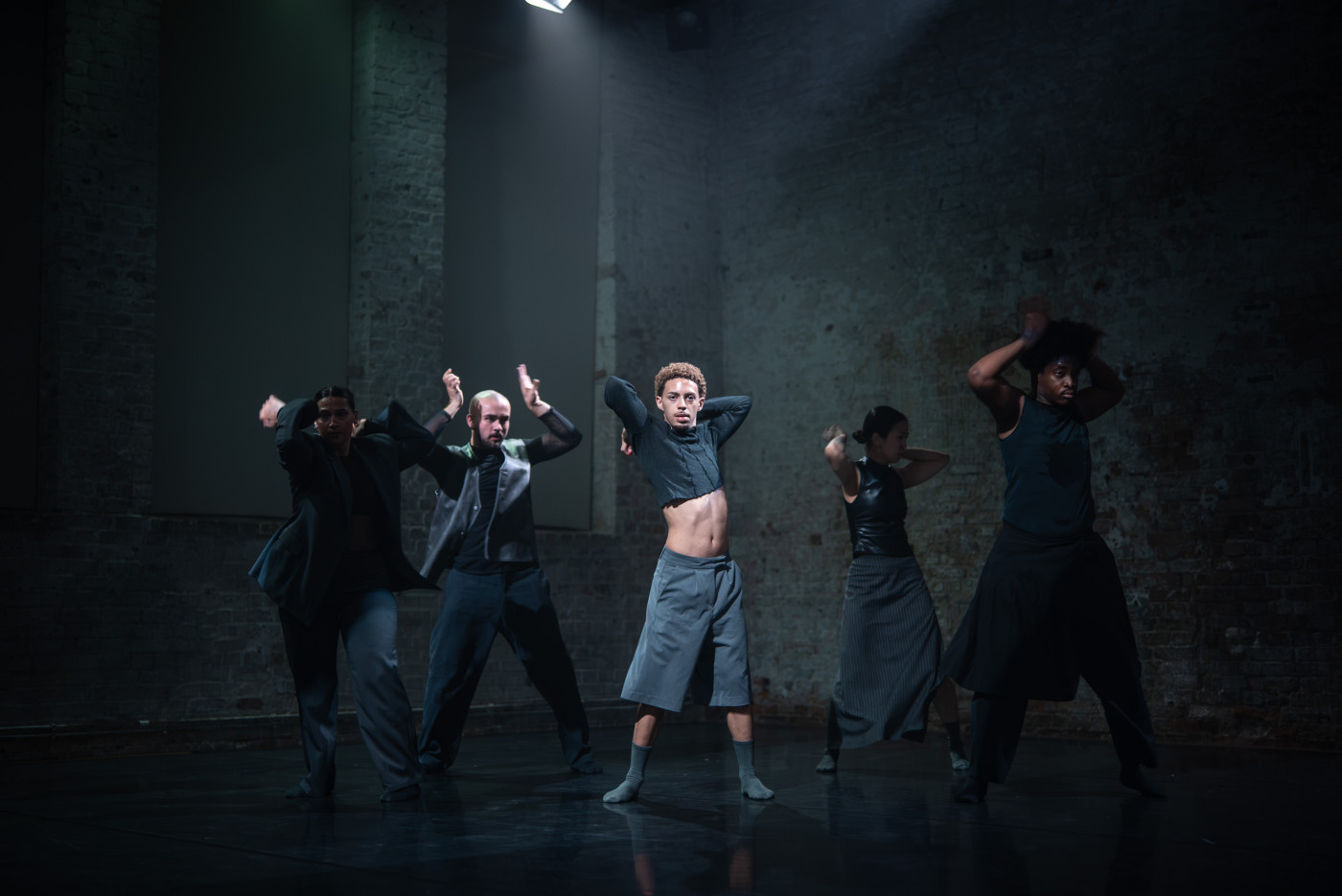
Yeliz Pazar is touring with the first German Waacking stage production and will be performing at DOCK ART on 3 and 4 July.
Text by Astrid Kaminski; with illustrations by Ela Sulamith
A translation from German that has been edited for clarity, with the aid of Google Translate
The days when Archie Burnett, the American authority on voguing and waacking, asked in bewilderment, "What's that?", are long gone. That was back in the early days of the Urban Dance Battle Funkin Stylez, when workshop participants enthusiastically mixed arm movements as if they were just movements, as if voguing and waacking were the same thing. Yeliz Pazar, from Düsseldorf, who is now considered a leading Waacking figure in Germany, remembers that aha moment. I catch up with her for a brief chat about this part of her pioneering phase, just after she presented the first German waacking performance for the theater stage at DOCK ART: "Point of No Return." Archie Burnett has long since adopted them as her mother.
However, it's not as if the dance styles Voguing and Waacking have nothing in common: Both make extensive use of arm movement sequences, both originated in queer US communities, both appeared around the same time, in the 1970s, both represent a form of empowerment, a code of community, and simultaneously a triumph of the individual over ascribed gender roles. Many urban dances have reversed the issue of marginalization, transforming social milieus that were labeled as left behind into scenes that set the tone—not without the subsequent risk of creating a new mainstream pressure. Yet, this "risk" doesn't really apply to Waacking, since those who dance the style are too diverse, too fluid, too unique.
Creating a stage choreography based on Waacking must still be a major challenge, as the style is built on a very specific set of vocabulary. Against the backdrop of the concept of variation as developed by the French philosopher Gilles Deleuze, a style can be understood as constantly evolving variations on a theme. Just as every flower is a variation and yet belongs to a specific plant, Waacking is not about copying, but about continuous development. This manifests itself in short sequences, then attention shifts to the next flower. Each person briefly comes into focus and then merges back into the group.
In "Point of No Return," however, the primary focus is on a group theme, not on individual positions. The solos have nothing to do with show effect or the desire to impress in the moment. Rather, they are aspects of an individual expression of the existential question underlying the dance piece: How do we move forward when there is no going back? How do we move forward when all the support of the familiar has crumbled away?
The five dancers (Yeliz Pazar, Mario Durán Abreu, Kevin Claudio Ponge Kassoma, Mathis Said, Enting Zhang) wear variations of gray, a combination of office and party attire, such as an elegant two-piece suit over a crop top. Other costumes combine trousers with skirts and asymmetrical lines. Against a black stage and colorless spotlights, the look exudes something apocalyptic, a grey-male world reminiscent of “Momo”, even if it's not about masculinity. At the same time, however, the cool atmosphere of a techno club emerges. The music by Artomatico, which in the first part blends industrial elements with powerful beats, reinforces this impression. It conjures up stormy threats, makes the ground crumble and tip, and machines roar. It hammers and propels.
The world created by the sound is as abstract as it is concrete for the dancers. Abstract in that they cannot (or do not) categorize the threats and unsettling noises. It seems unclear where the threat is coming from or what will happen next. Everyone must be prepared for anything. Thus, their gaze during the dance is always directed far into the distance. It only partially reflects their personal experience; their eyes must always be capable of triggering rapid reactions.
The classic waacking arm movement of striking and throwing, inspired by the nunchucks from martial arts, is adapted to the threatening situation. It appears as if the dancers are forming a protective helmet over their heads, then they break the movement to orient themselves with their arms or to defend themselves with a long arm and flexed hand. The nunchuck movement itself is also intentionally varied: for example. when performed more introverted, it seems like an attempt at remembering.
After these variations were introduced through solos and rhythmically intertwined and shifted group sequences, the dynamics and drama of the evening increases. In her solo, Yeliz Pazar introduces a pinpoint striking motion in which, paradoxically, the target is constantly missed. The concluding movement appears almost pantomimic in its concretion, yet the movement remains fluid and rhythmically perpetuated, so that each gesture is built up until the point something else is triggered, which then develops further. In this case, it evokes a solo-group sequence in which the whipping energy is strongly redirected into rapid, slightly off-axis spins. This forward surge, followed by a spiraling come to a standstill, reminds me of a feeling of panicked flight, where a moment of reorientation is suddenly necessary, a brief pause that doesn't interrupt the energy but rather beams it into perception.
The climax of the drama, but also the turning point, is the solo by Mathis Said, whose body is repeatedly brought down and tries in vain to right itself again. Only when they receive support from Mario Durán Abreu does the body slowly regain a vertical position, thus reorienting the choreography. The sound transitions from industrial to melodic, the movements seem more relaxed, open, receptive. The helmet movement from the beginning will reverse, its direction now moving from bottom to top: hopeful, receptive, almost prayerful. The despair and fear of the "Point of No Return," the moment when it is impossible to go back, has transformed into acceptance.
The conceptual approach of Yeliz Pazar's choreography reminds me of the core ideas in Jonathan Lear's book "Radical Hope." In it, he conveys his engagement with the philosophy of life of the Crow Nation chief Plenty Coups and quotes his words after the forced relocation and destruction of his people's traditions: "When the buffaloes left, the hearts of my people fell to the ground, and they could not raise them up again. After that, nothing happened." According to Lear, however, the chief's attitude after this end of history for his tribe was not one of bitter resistance to the death. Rather, he tried to accept the circumstances and gather new hope for the future—aware that he could no longer build on anything familiar and that nothing lost would return. It wasn't about blind submission, but about strategic adaptation with the goal of continuing to live life without merely enduring it.
I experience a similar situation in the final sequences of Yeliz Pazar's choreography. For the first time, there is a circular formation, as if searching together for a new ritual. The individual turns are somewhat marionette-like or carousel-horse-like, almost joyful—as if a vitalistic energy were taking hold of the bodies, almost without their conscious effort. A surrender to the energetic currents that carry them. A weightlessness that transcends.
The appreciation for the dancers' performance is palpable in the theater. About half the audience stays after the performance for a waacking jam session. I watch as small groups form, individualities emerge, ideas spark, and the hope for a response arises. Inwardly, I marvel at Pazar's team of artists. Compared to the charming and dedicated dancing community, the 360-degree presence in "Point of No Return" is even more striking. Add to that the devotion to the choreography, executed with almost unbelievable precision, yet it doesn't radiate a sense of pressure to do so. Rather, it's about togetherness, about searching, about the joy of skill, of progressing together, about a metamorphosis of technique into meaning.
About the drawing artist: Ela Sulamith is a multidisciplinary, audio visual artist based in Cape Town and Europe. Living in tension between two different continents, her artistic work is highly inspired by nature, sound and movement. Ela Sulamiths universe inquires into the question: “ What Is In Between? “ Thus she is ever longing to find union between oppositional elements, deeply moved by the beauty and brutality of existence.
instagram.com/ela_sulamith
Photo: Naima Maleika