

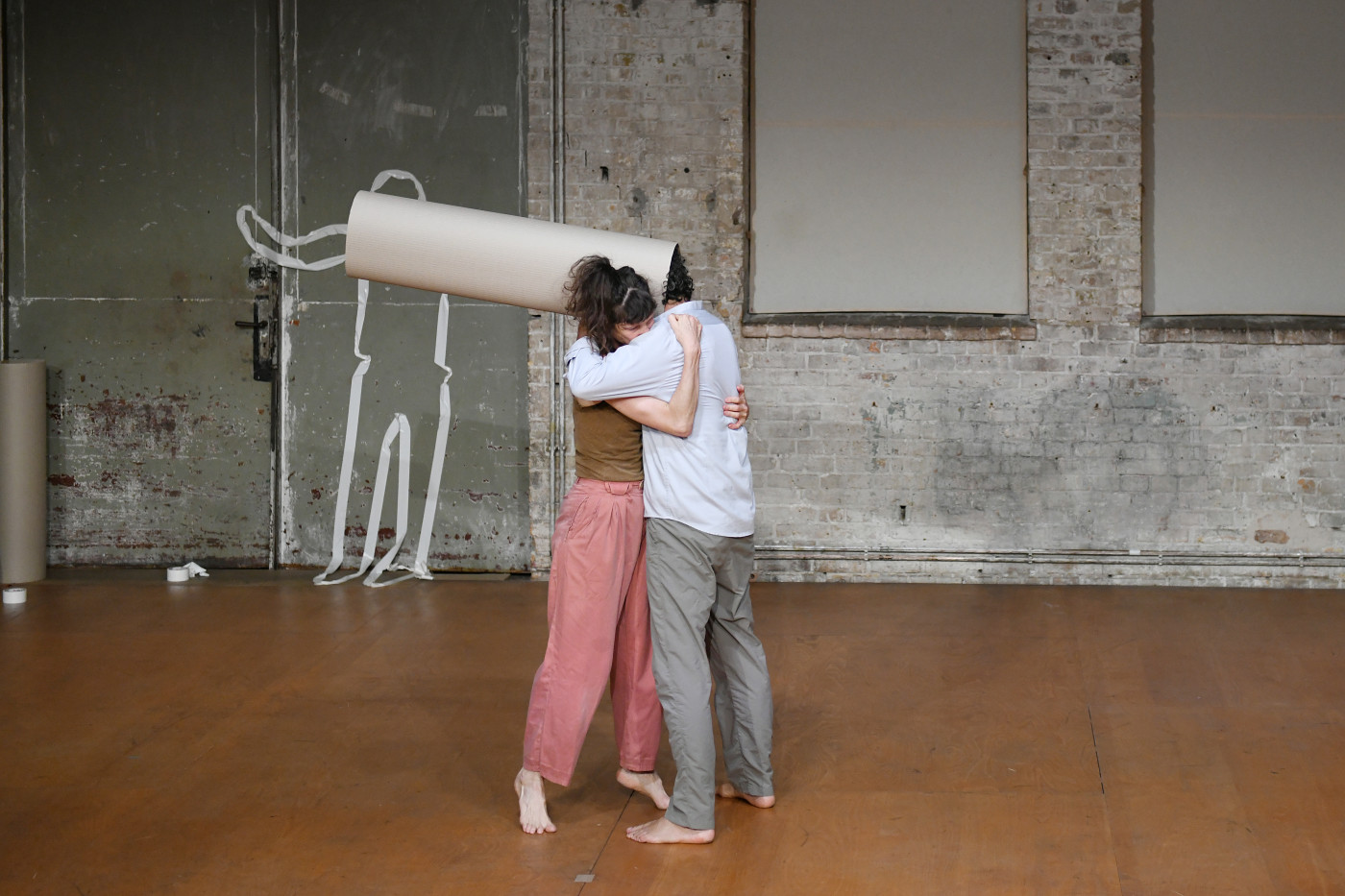
Where everybody had their first kiss
Ofra Idel is a choreographer and artistic director who is known for being a founding member of Machol Shalem Dance House (MASH) in Jerusalem – one of the first dance houses in Israel. From 25 to 28 June 2026, MASH will be presenting a selection from its annual festival for the independent dance scene at DOCK 11 / DOCK ART for the tenth time.
In this talk with Astrid Kaminski, she speaks about what it means to be founding a dance house amongst the Vatican, the Ultra-Orthodox and the Black Panthers in Jerusalem. She also speaks about her experiences as an Israeli artist in the international context after October 7th and the Gaza war, and how she looks at the collaboration with DOCK ART from this perspective.
Astrid: Ofra, you are coming to Berlin for years, but we don’t really know about your situation in Jerusalem. I want to ask you how it all started with MASH.
Ofra: It's quite some time already since we founded the institution, which was not an institution at the beginning, obviously. After I was graduating from the dance academy in Jerusalem, I was traveling with my dance performances to Tel Aviv, because there was just no base for presenting dance pieces in Jerusalem. There was only the dance academy, which is the main one in Israel. But after graduating, we were in a void. We had no support, no infrastructure, no festivals, residencies. So gradually, we started organizing a one evening presentation, a showcase of a collage of independent artists from Jerusalem. The first evening was 2002. We called it Machol Shalem. “Machol” is dance. And “shalem” has two meanings: It's one of the 70 names of Jerusalem, but it also stands for “a whole”, something that is “complete”. Because the evenings were a collage of different senses of artistic view, we thought together they would form something “whole”.
What kind of location did you find for that? And did you have any support?
No, at the beginning, everything was voluntary. We performed in a small Stadttheater, but very small compared to what we know from Germany. Anyway, we managed to convince the manager to give us the space for one evening. Everything was without payment, no rental, nothing. Everybody was just joining the initiative. And the place was full. It seemed like people were eager for this opportunity to continue – the artists as well as the audience. So we did it for two more years. Then it gradually became three days of this event. And then we thought, it might be recognized as a festival and we started approaching funders, etc. We also called the municipality and said: “Hey, we're in your theatre. We're doing a festival. And it's becoming like a little bit popular in Jerusalem,” and so on. And they said they could not support it any further because it was their theatre and they couldn`t give money to themselves. Means, we had to go out and look for another space, which was obviously such a big task for us.
But you found a very central spot, right?
We found an office that we could sit in, linked to a community center. But we still needed a studio. At this time, the community center, that gave us literally a desk, did a merge with another center which was located in the Musrara neighborhood, which is actually so close to the old city. It's just across, it's less than five minutes away. It's the most prestigious location in Jerusalem. it's so expensive, so beautiful, so close to the holy places. But! It was such a small neighborhood and it was neglected. I didn't know that Jerusalem had such neglected neighborhoods and locations. There was even no light. And the community center there was like not operating. There was nothing.
Why was the community center not operating?
Yes, you can call it a community center. But the community was not really existing. Because there were the Black Panthers, a movement that was started by people mainly from Morocco, who came to Israel in the 50s. The government kind of pushed them to this area, which was very close to the Jordanian border and they didn't put any effort in this neighborhood to have infrastructure. The people lived there in poverty and horrible conditions. So they started this movement against the government and to fight for their rights. The Black Panthers are very, very famous in Israel. Some of them still live in the Musrara neighborhood. And we, since we are all for human rights and for their rights, we thought we could collaborate with them. We even thought we were a bit like them – struggling for rights.
But not?
It turned out as a conflict because it was like we wer taking over their infrastructure that they have fought for so many years. And then the artists come and there's this process of gentrification, of houses becoming more and more expensive, costs of living... Additionally there were ultra-orthodox jews in that neighborhood who didn`t want us to walk around with the dance clothes. But when we started bringing international artists, who didn't understand the code at all and were walking there without the knowledge of how to dress. And at the other hand there were also very wild bohemian students from this cinema college that is still located there and is very famous. So, we had these very different communities in this neighborhood, but no one was connecting with us. We were located just in one room in that community center. Yet, we found that there was a sports hall there that nobody used. Finally, we got their agreement to do some performances there and we got funding for it.
City funding or national funding?
Two private foundations, the Jerusalem Foundation and Beracha Foundation. But we were having a hard time to be allowed to renovate even though no one was using it. Just for like not patronizing the citizens in that neighborhood. Means, we had a really, really complicated time. There were a lot of conflicts, also violent behavior towards us. Many times we had a performance, they just changed the lock so that we couldn't get into the hall. We came with a technical staff and the artists. And many times, the lock was changed even though we had an agreement for five years. This conflict brought us even to court for two years. All in all, we were there for 10 years. Some were better, some were really, really tough.
Under these circumstances you managed to be recognized as a dance centre?
Actually, for three years we established the criteria with the Ministry of Culture of what a dance center can be. We were the first example of this kind. By then, we already started traveling and seeing some models of very interesting dance houses and we said: Okay, this is what we want to do. Finally, we were recognized as one of the two dance centers of the time. Now, there are only seven, I think, seven or eight in Israel. So, it hasn't really expanded that much in 20 years.
But your festival was growing and becoming internationally recognized.
Yes, people from around the world wanted to come to see this, I mean, our festival in this little thing. And then the Ministry of Foreign Affairs said: why don't we open an open call for managers, curators of dance centers from around the world for them to come and see the independent Israeli dance? That was interesting because we were really trying to do something edgy and focusing on small productions, and they said, yeah, we see that there is a need to see independent dance, of a more edgy kind of genre. So, why don't we open together a small showcase? Hmm… And now we're getting into the 15th year already.
But you had to move then at a certain time. You had to move to the outskirts more of the city.
I mean, we had two years without a space because we were thrown out before we got to find another place. It's so complicated in Jerusalem. In Jerusalem, finding space that doesn't belong to Vatican or other entities is just impossible..
Who kicked you out?
The community center. After being in court, they were like, we're not going to give you another contract.
And the community center is in the hand of the Ultra-orthodox or of The Black Panthers?
The fight was with the community center’s board. As for the Ultra-Orthodox, we actually managed to get in touch a bit, for example to have a dance class for women after birth only, and so on. We were trying to collaborate with everyone, but the community center’s board was blocking every single collaboration. They just didn’t want us to be there.
Now you are at a place which is an old cinema.
Yes, it’s not in the center center, but it's still in the geographic borders of Jerusalem. In a more industrial area, in a mall, basically. There's one floor that used to be a really huge complex of cinema. Really, really beautiful. And big. It was of a branch that operates cinema in Israel. I was there at the movies as a teenager. Like everybody. Everybody knows this place because everybody had their first kiss there.
Wow!
So, we knew the space. It was a dream to be in this space. And it had a parking lot so that it was very convenient for the audience as well. But: It was in horrible condition when we found it, and it is very expensive to rent.
How did you find the courage for it?
We said to the municipality: Look, there's got to be a serious renovation. But finally, we found something. Aren't you happy for us? And indeed, they did a calculation for three different organizations. And they gave us some money for the very, very basic renovation. Basically, we got the rooms, like, floor and walls. But it was 10 by 10, without fillers, seven meters high of a ceiling. It was a dream for us. And total independence.
So, did you finally get the money for the renovation from the municipality?
Yeah, for a very basic renovation. Plus for the rent. We pay 35,000 shekels a month. It's the equivalent of 11 000 euros.
That's a lot. It’s such a shame that there is so little public space in the public hand. It’s the same in Berlin.
The municipality was acknowledging the complicated situation, but because they are aware of the fact that the place could be a lifesaver for us and if we didn't find a place we would close, for them it was a situation in which they were giving priority to rescuing us. We were rescued. But also, it's that they like these organizations like us.
For how long is your contract then?
It was for five years and now it is over. After that, the owner was wanting to give us only a contract for six months and raise the rent by 30%. In the same time our budgets are lowering, obviously because of the war, but also because a lot of new organizations are coming in and are eating their part of the pie. Anyway, we managed to negotiate and get a contract for one year, which is finishing in November, this November…
Gosh, it's so existential!
Yes, because the owner wants to tear down the building and to build very fancy luxurious apartments for rich people. But since he didn't get all the permits yet, he's allowing us to stay a little bit longer. Now, the municipality is starting to understand that the situation is very critical. And we hope that in the next few months, we'll hear some good news about a permanent house by the municipality to allocate. And then we would only need to pay the ongoing expenses, like electricity and the other bills. To be released from this kind of leases would be a huge step for us, you know, no one could take it away from us anymore what we have built up. Okay, it`s a dream again.
If you are depending on city funding, city support, what does it mean to you in terms of politics? I mean, do they now – with the war – do they also imply, certain policies on you? Like, what is politically wanted and what not and so on? Is there a more controlled situation in case you get city funding?
First of all, we don't know because we never got an allocation-status from the municipality. But I don't think it will matter. As for now, the city mayor is a very open-minded liberal person. He gets, of course, a lot of stress from the orthodox because they're a big part of the city council. But he himself has really, really helped the arts organizations. He actually managed in a few years, to increase art funding in Jerusalem. Again, we don't feel that because our budget, after all, it's lowered due to the concurrence with new organizations, but it's not because of him. He even comes sometimes to performances. Of course, we don`t know if he will be elected again. But even if the mayor changes, by the law, the politics cannot control the content. If there is something like political pressure on culture, the department that is responsible for the subsidies can say: We give them money by the criteria and we cannot control the content. And the content is not part of the criteria. This is very dry but effective and I must say, so far we had no problems.
You are working in a place that has so much of a cinema tradition. Does that play a role for you?
Not in a direct sense. But during COVID we started to produce a lot of VR content.
We gave the audience VR glasses, and we produced content that was filmed in a 360 sphere with a 360 degrees camera. And people could watch a performance, but from a very specific point of you: from being in the center of the stage. We thought it would be very technical, and we would only find kind of a solution for a certain period of time, but it will be a trendy thing, and it will be over. But then we found that this media was so strong because actually, when you put the VR, you see the dancers sweat and all the veins, and it was even much more alive than we were. And people were really liking it, so now it's developed a lot. And we have special VR content. It's not documentation, it's not like a choreographer comes and he does what he does, and then a few hours of adjustment. Only now, after a few years that we managed to use these tools, we understand what we could do with it and we're starting to develop some original content to it. It became something of its own. It's not cinema, but, it's kind of a projection, technically it`s somehow close to cinema.
As for your mission in general: On your website you mention your mission would be bridging different communities. Is that referring to what you already said, to the beginnings with the Ultra-Orthodox community, the Black Panthers, and a let-to-itself-neighborhood, and then also bridging different aesthetics? Is that what is behind it, or is there something that we haven't spoken about yet?
We have different projects in this sense. We don't do all of the projects all year round, but what we did have in the past few years is for example a project for producing children's performances for kids on the autistic spectrum, meaning designated performances for children with neurological problems or difficulties. That was a big project with the support of the Jerusalem Municipality and the Lottery. Actually, the Lottery is for sponsoring arts in Israel.
It`s the same in Germany – to a certain degree.
We managed to host, I think, at least 30 groups of children, from the very high level on the autistic spectrum to the lowest, many kids who do not speak and never saw dance. And after all, they found themselves on stage doing a small workshop, a small dance. It was one of the most beautiful projects we've ever done.
Did you also perform for Arab schools in Jerusalem?
Indeed, we did. But this was another project, in Beit Safafa, a neighborhood, which has two very big Arab communities We also performed to Ultra-Orthodox and Orthodox populations, which are completely two different communities. Other than that, we have for example two festivals for women only. We don't produce, but host them, assist them and encourage them. So, we have a lot of populations going in and out of the space, a lot. Unfortunately, ultra-Orthodox men and Arab population don't tend to come so much for these events, no matter what we do. In general, it's just a third of the population in Jerusalem that is secular. (.) So already starting from there, there is an audience problem, because in many peoples eyes, religion and contemporary dance dont go so well together. Like this, it is a necessity and a social mission for us to do education. We go to schools. We go to elderly houses. And when the war started…
Everything was for nothing?
It’s too early to say. There is too much to say. But we started another project. I don't know if you know: there were dozens of thousands of people without homes in the north and the south of Israel. They came to hotels. A lot in Jerusalem, Tel Aviv, and around the Dead Sea. They were populations that were suffering highly from traumatic matters at this time, including kids that saw their parents murdered in front of their eyes. So, we came to all these centers, evacuated population centers, and projected VR content. Some of it was dance, in other cases, we just used the infrastructure of the VR to bring different kind of entertainment. And we understood that it's such a powerful tool because it doesn't matter if it's a tour to Milan, or a tour to a museum that they're in, or a game: for the kids it was like a rioting in Disneyland. And they would sit together and they speak about it, they can express their feelings and they hold hands and they behave like a group, even though everybody is sort of in his own world. It's such a powerful social medium. And just then, we understood that. Subsequently, we now go to elderly houses and hospitals, and to all these kinds of populations that can't join social life. All kinds of populations that could benefit from this kind of tool and, of course, from dance.
Seems like you almost have no time left for dancing.
Whatever happens, we will make that time! At the Jerusalem International Dance Week before the war, we had a hundred international managers coming, to see performances, which also include the Jerusalem International Choreography Competition – a two days competition. The only one in Israel that hosts 10 groups from around the world. Again, it's only independent dance, not companies. And they only win prizes of 4000 Euro and down – but still!
In comparison with before the war: how many out of one hundred dance managers and curators are coming?
I think they were 56 last year. That's including international artists, not only managers. And this year we'll see. We're now at a stage that we just hope it will happen, because so many other things can happen from one day to the other. The fact that we're here in Berlin and the tickets are not canceled, and there's no threat so far, and we can leave the house and know that hopefully we can come back, it`s already encouraging.
In Berlin you are hosted by DOCK 11 / DOCK ART for already 10 years. What does that mean to you? Do you have other collaborations and supporters like this around the world?
It's a huge gift, of course, for us as an organization, and for the Israeli artists that are being selected each year. We don't have another collaboration like this. It`s an anchor and the only stable thing we have at the moment. Usually when artists are being invited or if we have exchange, organizational exchanges, it could be two years and then it's over because of a lack of money or the priority changes. We don't take anything for granted, we are always prepared for everything and nothing. Also, it's a bit sad to say that I think DOCK ART is brave because they still invite us. I mean: Why does someone has to be brave to invite artists? But this is the situation and there are probably facing critics. So, it's brave compared to other decision makers around the world.
How did your experience of Berlin after October, 7th, and after the Gaza war started, change, how about gestures of solidarity or hostility?
I mean, I walk as a tourist in Berlin and have a very nice time. I don't feel scared to speak Hebrew unless, you know, I'm in a cab. But I don`t live here. Whenever I come, I am completely in my own world.
And how do you feel about security? At DOCK ART, there are no body control checks. And you are not supposed to use weapons for self-defense, which is now, as I understand, quite common in Israel. How is that exposure to other forms of social behavior in the world?
It's very interesting that you're asking because no one asks us, nobody understand this kind of vulnerability that we're in. And when we say, we go to a hotel abroad and we need extra security, like we put something in the door that will make a sound if someone opens the door, nobody understands this kind of behavior. But I have a very strong sense of vulnerability, even extremely. When I'm abroad, I must say, I try not to mention it because it's weird for people. They react like: “Oh, you're scared. Why are you scared? You're with us.” But you know, if someone looks at the list of participants of a festival, everybody can find out that I am Israeli in one second and walk with me to the hotel. And I cant defend myself. It is very weird, but in Israel, we either have a weapon or we know how to call right away or we know where not to go. So, at one hand, here, it's freedom. Still, I never walk and look backwards in Berlin or in Warsaw. When I go out of the house in Jerusalem, it's stressful. We had a lot of terror attacks and my children were very close to them. Compared to this, I am so free here. But if something happens… I try to dont bridge the situations. But, of course I carry my life with me, and it's interesting because I think, none of my friends, of my international friends, realizes how free I feel and how vulnerable at the same time. It's so extreme.
I see. But did I understand correctly that personally you didn’t experience that the moods have change towards you, or that you got boycotted because you are Israeli?
Of course, there is a huge boycott. Most of the artists don't tour at all. Some of the very well-known artists in Israel have zero tours. It went from a hundred percent to zero. Some of them kept maybe 15% of the actual invitations or contracts. I am not talking about contacts. Contacts stay contacts. People ask how I am, et cetera, but I'm talking about invitation. There's a huge discrimination.
This is quite an exception that you were going to festivals in Warsaw and then to Berlin?
It's very exceptional. People are like: What? You have a tour of two performances in Europe? Before, Israeli artists were almost never in Israel. They used to perform all over the world all the time.
I want to speak about passports. In “thisispain”, a performance of the MASH festival, there’s the question about passports. Many Israelis have a second or even a third passport for security. If you have not, you're even more vulnerable. How about you?
Yes, it's very much spoken about, of course, after the war and after the hostage situation, where a lot of hostages were saved literally because of their second passport. I mean, say, they were released before the others. Now a lot of people search for other passports, the war was exhalating this sense a lot. But it's also not only because of the security situation. It’s also because of the politics in Israel.
There is also this question from “thisispain” of “This is my land, but until which point?”
We have elections in October and people I know are just waiting to see if they stay or not, depending on the results.
Do you have a second passport yourself?
No, I don't have. Yet my husband has a second passport. And we started with the kids to do this process. I could do it as well, but I refuse. I'm not going anywhere. I'm not going anywhere.
No way?
Of course, something else can happen. There could be an atomic situation in Israel. If I have to run for my life, I will run for my life. But I am not going to move out of the country. I love Jerusalem.
Speaking about all these questions that are so existential, how do you deal with them in your dance house? Do you develop certain formats or methods to speak about content like that?
First of all, there are these talks created by Sarah Holcman, a dance director from Israel – I mean, she's originally not, but she's Israeli now, she's originally from the United States. She used to work with the Suzanne Dellal company as an international manager, and now she has her own institution. And she produces and creates spaces to talk about these issues between the Israeli community itself, and also abroad via Zoom. She invites all kinds of dance lovers, critics, managers, people she knows internationally. It was fascinating to hear voices from the community and from abroad. How they see it, why do they feel or operate in a certain sense. I think the same is true for a lot of people abroad who really want to listen and share and speak about the pressures they feel.
Beyond that, I just now had three talks about it. Also, one of the festivals that I'm going to visit in two weeks suddenly experienced pressure not to bring the Israeli company that they wanted and they phoned me…
So, you need to explain your political point of view very often?
For the past three years. But why do we need to explain? I mean, I understand, but still why? Am I the representative of the government? Why do I have to explain that I'm taking money from the government which doesn't belong to the government? The money belongs to the people, not to the government. They're just the distributors. And I want to use my tax money for good things, to heal the world and to open bridges and dialogue. Why do people look at us artist as if we were just a branch of the government? We have to explain every single time why we do this, why we do that. It's tiring, very tiring.
As for your latest performance work “Sounds Alive”, you are dealing with the effect of war on women. Mothers don’t have to fight in the war directly, but have you also been in the situation that your partner had to go to war?
It's a very good question. When we have an after-talk after the performance, a lot of people ask that because emotionally this performance is quite draining. It's really not an easy performance. We just happened to have it last night and people were totally shocked. We were supposed to have an after-talk with a moderator and when I was coming to the stage, she started crying. She said: “I don't know if I can moderate.”. As for your question: I will put it this way: I am fortunate enough to not be in a very traumatic personal situation in that war, because in this case, I think, I might not have been able to create a piece about it. I don't know, I don't want to think about it, but luckily I don't have a firsthand experience. Yet living in Israel in our time is traumatic by itself. We're all post-traumatic. I know it sounds like very banal or very kitschy, but this is our reality. A lot of artists did not go to the studio since October 7 or had a very long pause. Our performance was like dancing from shock. Like we have no idea what we're doing. When I created it, I just felt we have to go back to something that we remember that was in our lives before. Remember we were in the studio and we're doing things with the body and experiencing feelings through the body.
We have to start learning from scratch, how to live our lives that we had before.
Why only women?
The only thing I had thought about, before starting the piece was indeed to work with woman only. I felt that this kind of connection is important now. So, I just knew the cast. And then it was like going into a ceremony of expressing shock together. A ceremony through which we went again and again. And then we would cry and then we would have a break. But if we would hear the news, we couldn`t go back. This way we banned the news, because otherwise we could not concentrate. And we felt that all of it was just like flowing out of our body. I always have a very hard time in the studio, but, weirdly, this time it was so easy. We never even changed anything since we created it. It's so contradictory, how easy it was to create it, because it's a really hard performance to do and to watch. It is like we opened a channel.
Interestingly it is the first time that you perform yourself at DOCK 11.
True. Usually, I present the pieces of others. Yet, I presented already one piece by myself, but I wasn't dancing in it. It's a solo for an Ethiopian dancer who was walking to Israel all way through the desert. It was about his life story.
Now, it is somehow about your life story, but it’s also not. We don’t know exactly. It`s a very extraordinary experience. It’s about coming to this point of a thing as such. The performance is not a tool to express something but it is the expression as such.
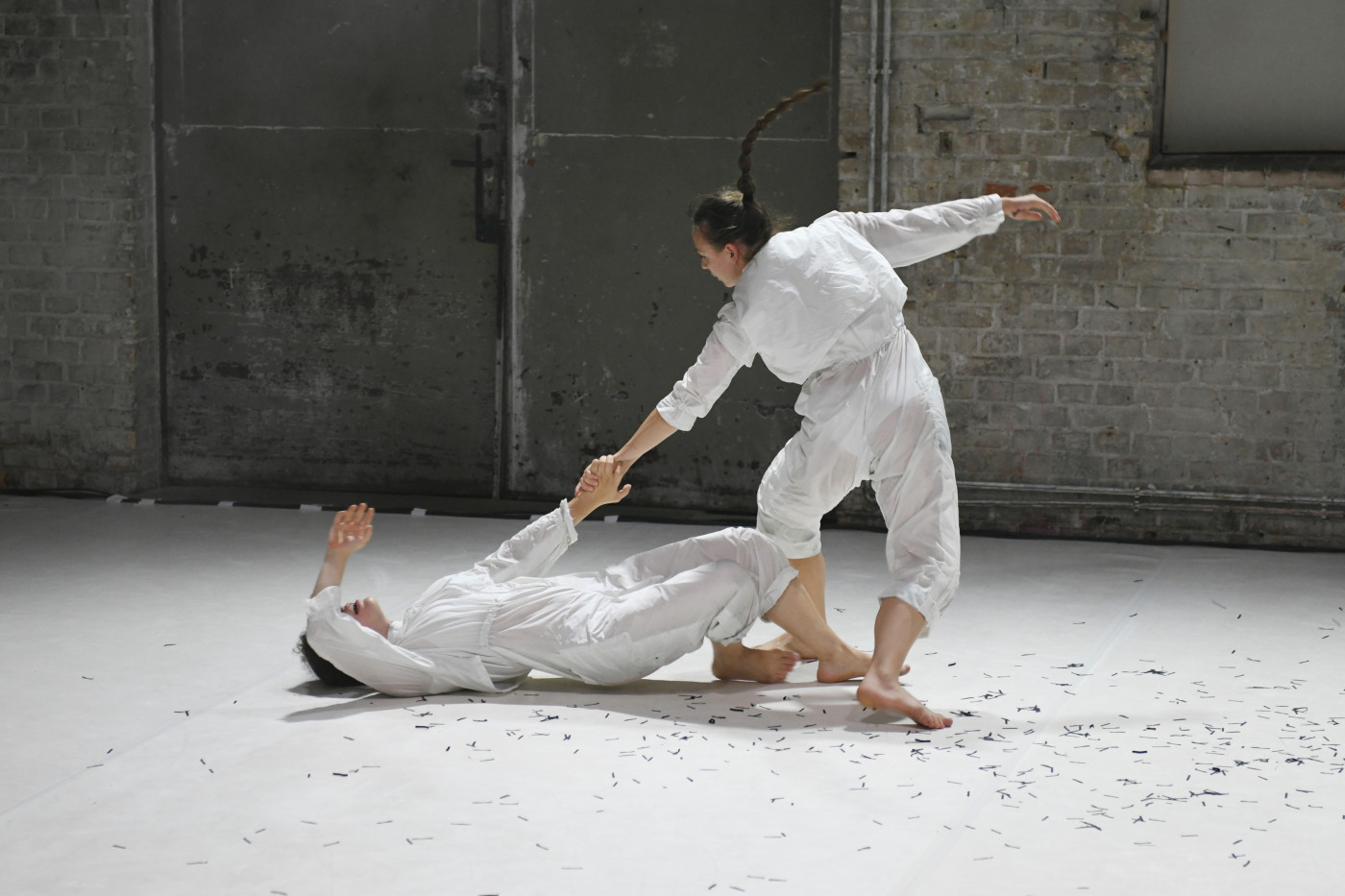
Yes, it really speaks for itself. You are seeing images that we don't want to explain so much. Also, the three of us, me and the dancers who are the co-creators, did not necessarily speak about what we were doing. We even don`t want to define it. That's why we wear white suits and the stage is very, very simple. In a way it is very generic.
I think what’s happening in the piece in terms of language is very important. The only “word” that is communicated is “Ah”.
Maybe it`s a fact that we cannot express our thoughts as Israelis abroad. We don't have a voice sometimes, which is hurting. But there is another fact that concerns us even more as women: the decision makers in Israel are only men, 90% of them are men. Every decision of theirs is literally affecting our lives so dramatically, and we felt that women don't have a voice. The government is silencing us. So, it is very apparent that we cannot speak out on so many different levels.
Productions of the 2026 DOCK ART / MASH Dance Edition include:
THISISPAIN
by Hillel Kogan
The War Within
by Iris Erez in Kollaboration mit Elad Vazana
Sounds Alive
by Ofra Idel
Victims & Images: Vol 2
by Roni Chadash
Photo: Barbara Dietl
By playing this video, you accept Vimeo´s privacy policy. Read more in our privacy policy and at https://vimeo.com/privacy.