

Brought to Bloom
Historical encounter of female artists in “Flos Vanus – Adabana” by Yui Kawaguchi, Julia Kursawe and Anna Fusek as part of the soundance festival berlin, 14 June 2026
English editorial translation using Deepl; original German text
by Lea Pischke
A person holding a cello stands behind a music stand on stage and addresses the audience warmly. She introduces the evening, telling the story of Izumo no Okuni, the founder of Kabuki theatre in Japan in the early 17th century, and Isabella Leonarda, one of the few female composers of the Italian Baroque period whose works have survived. The works of these two women, who lived in the same century but never met during their lifetimes, will come together on stage at DOCK 11 within the space of an hour.
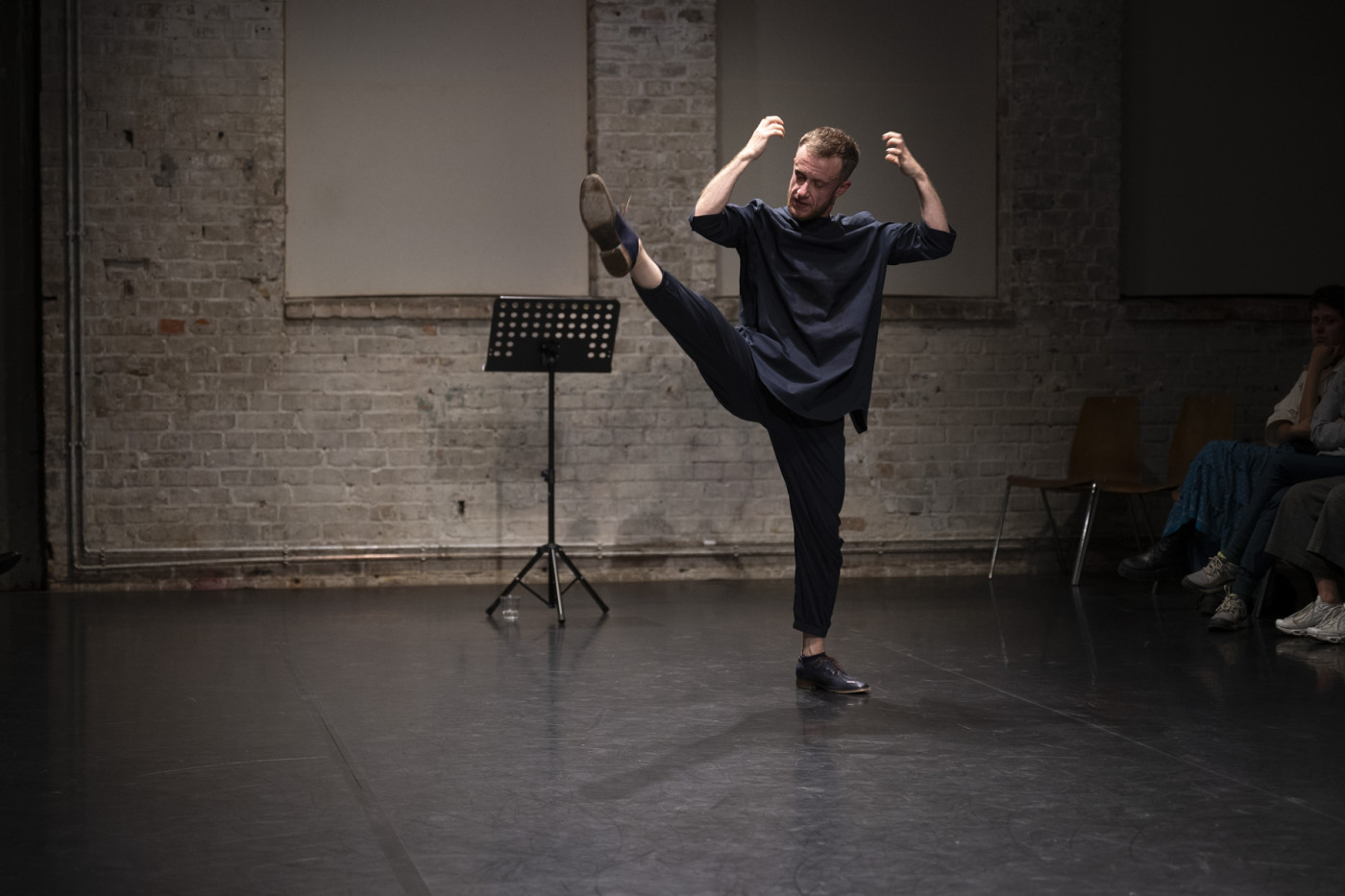
Following the brief speech, the sound of a flute can be heard. Drawing inspiration from Kabuki theatre, where performances are accompanied by flute and drum music whilst the curtain is being raised, the musician Anna Fusek walks from the theatre foyer to the stage, playing the bamboo flute. Already on stage is the cellist Julia Kursawe, dressed in a neutral, functional robe with a faintly Japanese feel. Choreographer and dancer Yui Kawaguchi emerges from the back door in the darkness and glides into the action on stage.
“Flos Vanus – Adabana” is a hybrid of a concert and a dance performance, which are effortlessly and pleasantly interwoven without the respective art forms getting in each other’s way or having to vie for the audience’s attention. The title itself is a hybrid, European-Japanese composition: the Latin “Flos Vanus” translates literally as “futile flower”, whilst the Japanese word “Adabana”, on the other hand, means the “flower that bears no fruit”. A political statement: ‘Flos Vanus – Adabana’ pays tribute to the artistic work of two women who, during their lifetimes, were probably unable to enjoy the fruits of their labour to the same extent as their male counterparts.
Judging by the choice of instruments and the melodic and harmonic structures, the pieces performed are either Japanese compositions or works of early music, though occasionally they also include original works by the ImPuls der Suite ensemble. Drawing inspiration from Okuni and Leonarda, however, the trio does not feel bound by any supposed obligation to perform exclusively pieces or excerpts by these particular artists. This also explains the dramaturgy of the evening, which opens with Kousaku Yamada’s 1927 piece for bamboo flute, ‘The Red Dragonfly’, thereby making it clear that ‘Flos Vanus – Adabana’ has no historiographical mandate.
Brief interactions between the three characters highlight the action on stage: as Fusek sits at the spinet, her playing is partly disrupted and partly accompanied – in a comical and friendly manner – by the nimble right foot of Kawaguchi, who is lying beside her. During an improvisation for cello and Irish thin whistle, the dancer stands behind the musicians and, carried away by themusic, cries out “Wuhuu!”, quickly and bashfully throwing a little confetti. Sometimes charming, sometimes a little childish and seeking applause from the audience, such small glances and gestures settle over the dance and instrumental work like post-dramatic little fibs: “Yes, we are human beings and not performers trapped in our roles,” seems to be the message.
However, “Flos Vanus – Adabana” derives its aesthetic vitality from a number of other small, brilliant moments of interplay between dance movement, musical performance and scenographic interludes. An example: After a few performed pieces, Kawaguchi slips into a kimono, ties the obi (belt) and sits down on a stool. She then folds back the kimono in several places, baring one shoulder so that the patterns on the inner fabric are visible. To the accompaniment of a fast-paced piece, she begins to dance exuberantly, her limbs becoming part of the composition of fabric, texture and colour. As she leaps, she bends her arms and legs; the fabric folds upwards and, for a brief moment, it seems as if she were literally suspended in the air. It is this interplay of inside and outside, the sheer quality of the fabric, that shapes and directs the viewer’s gaze upon the dancing body.
Kabuki theatre has its origins in dance: at the end of the 16th century, the young Izumo no Okuni was a dancer at a shrine in the Japanese province of Izumo, from where she set off for Kyoto, the capital at the time, to raise funds for the shrine through dance performances. She presented a mixture of dance and sketches of her own devising, alternating between traditional men’s and women’s attire. Her unusual style of performance proved popular and quickly gained a following. Kabuki theatre, which developed from her solo performances, experienced its first heyday in the early 17th century and was initially performed primarily by women, mostly courtesans. It was only later that the convention of an all-male ensemble – which also took on the female roles – became established.
The composer Isabella Leonarda also seems to have been born at a particular moment in history which, as a woman in a patriarchal society, allowed her to compose and to sign her compositions with her own name. After the end of the Renaissance, at the dawn of the modern era, it was female composers in particular – although this is little known – who shaped the development of Italian music through their works. Isabella Leonarda, the daughter of a wealthy northern Italian family, was sent to a convent at the age of sixteen – as was often the custom at the time – where she was taught to play the organ by the organist and choirmaster Elisabetta Casata and composition by the choirmaster Gasparo Casati. During her lifetime, she composed over 200 works, with a particular fondness for motets, and belonged to that group of women who, in the early 17th century, were active as musicians, composers and choir directors within the context of their monastic lives, and who exerted a major influence on the development of the Italian Baroque.
The performance by Julia Kursawe, Anna Fusek and Yui Kawaguchi is a ‘contemporary flower’: it draws on Izumo no Okuni and Isabella Leonarda, and some of their works are also performed, without, however, overshadowing their own contemporary contribution: The plasticity of the sound produced by the violin and cello, at times employing the “sul tasto” – bowing technique, the piercing tonality of the spinet and the powerful, almost ticklish playing of the flute create a sensory cloud of perception that brings together the centuries that have passed since the lives of the two artists, offering us a multidimensional listening experience.
Furthermore, the particular focus on these interactions means that the musicians’ physical presence is subjected to a more intense theatrical scrutiny than is possible in a concert: the melodramatically raised eyebrows, the tucking in of the chin or the swaying of the head – gestures that occur almost reflexively whilst playing an instrument – have the same effect in ‘Flos Vanus – Adabana’ as the heavily applied make-up in Kabuki: they emphasise emotions or character traits.
Another subtle nod to Kabuki theatre towards the end of the evening: the dancer Kawaguchi leaves the stage and appears behind a window in the backstage area. Like a character in a play – a shadowy presence, separated from the main action – she stands behind the window, whilst the latticework of the windowis illuminated: a nod to the shoji doors found in traditional Japanese homes and a very fitting way of incorporating the architecture of DOCK 11 into the performance to great effect.
photo: Diether Hartwig
By playing this video, you accept Vimeo´s privacy policy. Read more in our privacy policy and at https://vimeo.com/privacy.