

Becoming Archive
Dear Peter,
It’s hard to believe that your first solo at DOCK ART was ten years ago. It was called„p“. Back then, when you unfolded your studio here in the theatre hall, it felt almost like an attempt to bring order into a complex web of memories and experiences – as if you were tracing which threads of your work had carried through the years, which had ended abruptly, and which were still hanging loose, waiting to be woven further. Perhaps „p“ also hinted that all these threads would one day form a pattern, an image – a puzzle that continues to assemble itself, then and now, and beyond.
Your new solo announces itself as a kind of reflection – a condensation of ten years of solo research alongside your work with Cranky Bodies a/company. „Less talking”, you say at the start, and you mean it. And yet the evening does not begin on stage, but already in the foyer. You move among the arriving guests, greeting, introducing, quietly weaving a network of encounters. On the long bench sit people from Moscow, the U.S. and Finland – after your brief welcome they remain in conversation. Even before anything officially begins, a small, fleeting community emerges, born of mutual attentiveness. At some point we are gently invited into the hall; the transition feels less like a scene change and more like a subtle shift in perception.
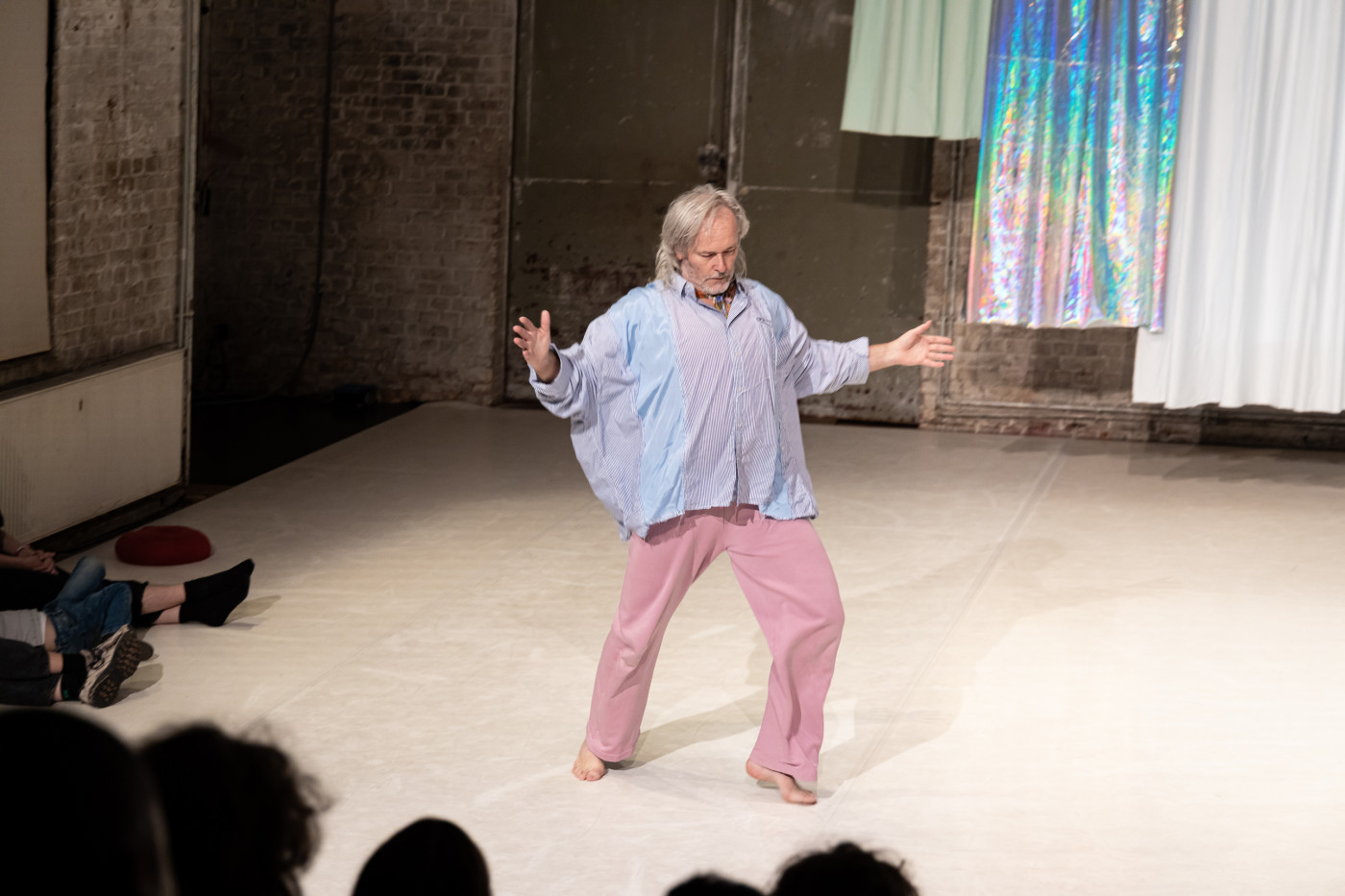
Then the music begins – Éliane Radigue’s organ piece Occam XXV. Its 44 minutes and 30 seconds provide the temporal frame for an open improvisation in which you interlace choreographic principles, personal memories, and your vast movement archive: Your body moves through the space, as though re-discovering its own limits and those of the room. Your arms explore the air in front of your chest, above your head. Your torso curves, drawing the space inward; fingers probe, wrists swing, waves ripple through you. And yet you remain grounded. Every movement, however light, grounded in the earth. That groundedness becomes the basis for sensing, responding, releasing. I think of Irene Dowd’s Taking Root to Fly, of the „giving weight” of Contact Improvisation, of Nancy Stark Smith’s Underscore, or the Alexander Technique – all pathways toward centering, opening, and interrelating through the body.
What do you perceive in that small triangle between arm and torso? Where does your attention wander when you observe yourself?
Your body holds an archive of more than sixty years – dense with training, improvisations, encounters, teaching, learning, friendships, all layered delicately atop one another. Chi Gong, Eva Karczag’s Swimming Dragon, Steve Paxton’s Material for the Spine, Trisha Brown, the voguing walks of Trajal Harrell. Your body carries traces of them all.
Meanwhile your movement shifts: at times expansive, at times more planar, then tipping backward – a beetle on its back, searching for balance. Radigue’s organ music unfolds alongside: almost motionless, with minimal changes that grow steadily more intense. A single long drone gathers mass, thickens, and slowly falls back into silence. The transformations are so subtle that one perceives them only in retrospect. The motion of sound is barely audible, and yet palpable.
What do you hear that I hear differently?
And what might slip past us both?
Radigue writes: „We live in an universe filled with waves.” Between the earth and the sun, down to the tiniest microwaves – within that spectrum lies the narrow band between 60 Hz and 15,000 Hz that our ear transforms into sound. The hovering drones seem at once motionless and constantly shifting, an ambiguity that creates a state of meditative alertness. The music could last twice as long – or forever.
As the sound thickens, your movements become more intricate: spirals, diagonals, rotations of the wrists. The flutter of your shirt produces its own sound, becoming part of both choreography and composition.
What is different today from yesterday? What remains unchanged?
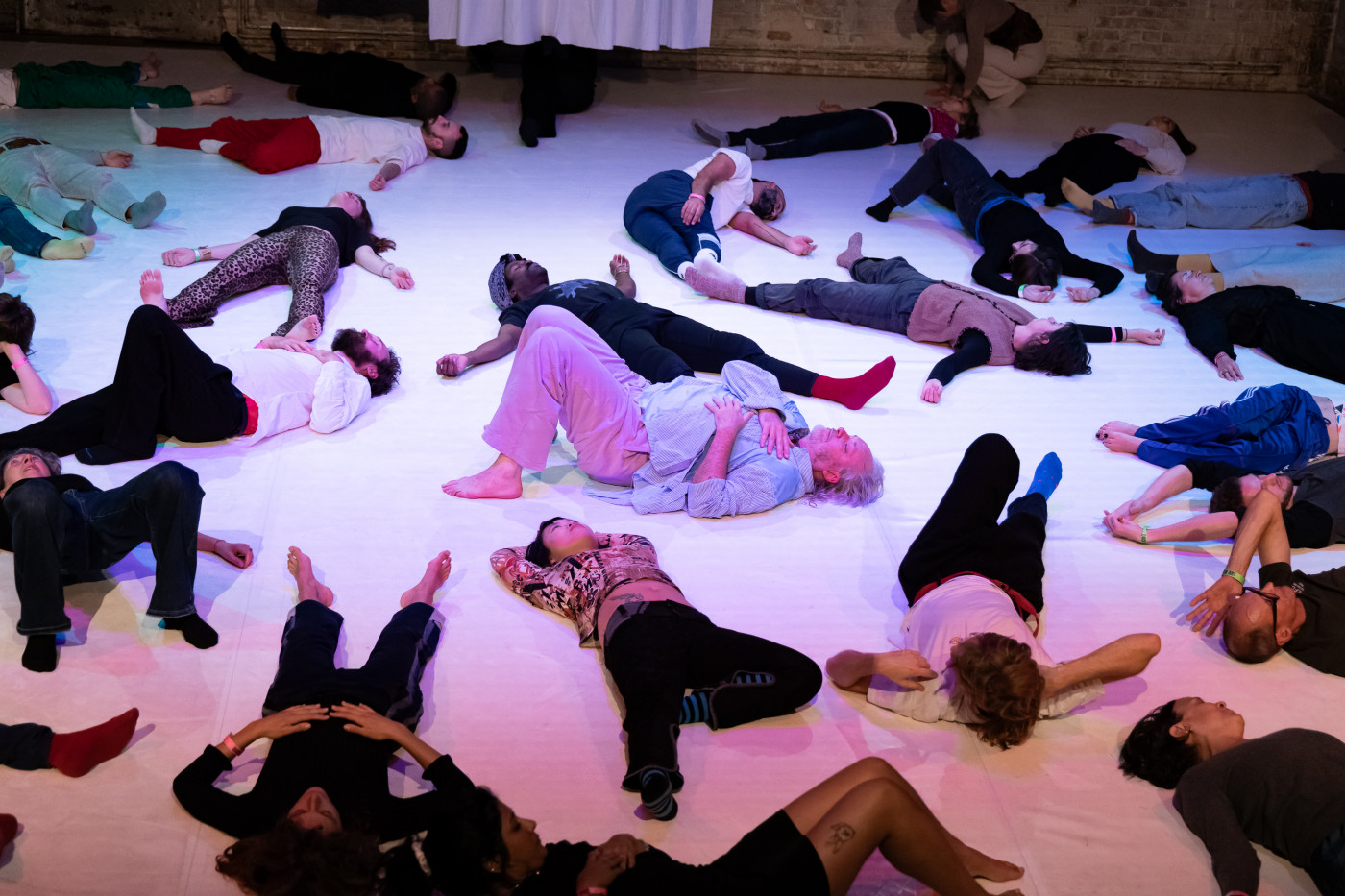
The evening closes with an invitation to us all – to join the Slow Rave, to move as slowly as possible. A continuous flow, punctuated by moments of self-inquiry: Can it go even slower? How slow is slow? It becomes an attention to breath, vibration, grounding – and to time itself, to the weaving of sound, movement, and space. The evening doesn’t end abruptly but gradually dissolves: body, music, and space merging into an extended, open stillness.
Look around you. To see is to be seen – and to perceive what remains.
With warmth,
Jette
Jette Büchsenschütz
By playing this video, you accept Vimeo´s privacy policy. Read more in our privacy policy and at https://vimeo.com/privacy.