

What Lingers Between Us: Risk, Trust and Relational Ethics
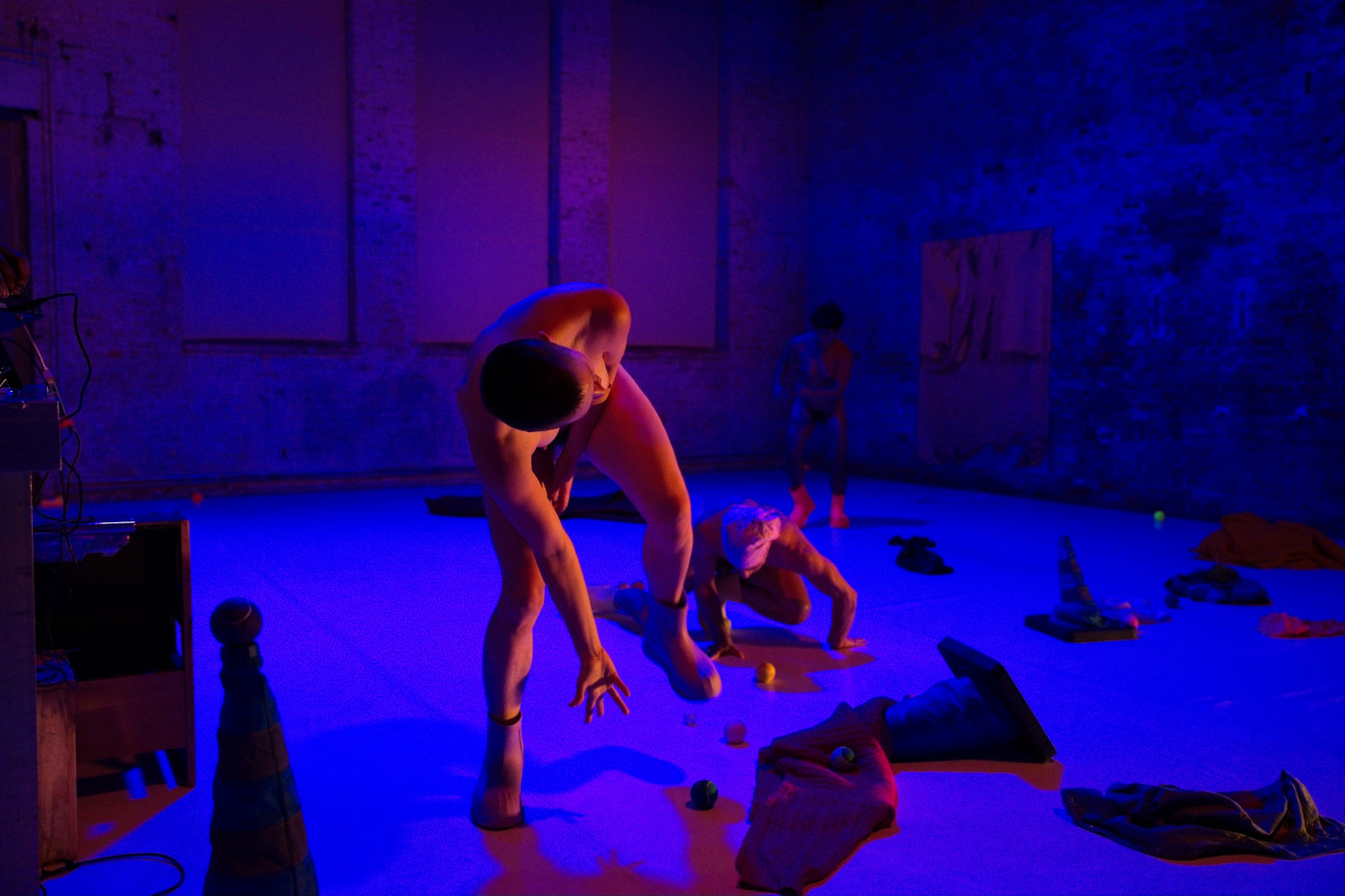
A playful register opens the space: balls, bags, fabrics, boots, colorful tennis balls, and ping-pong balls scattered across the floor forming a small ecosystem of potential accidents. Much of it flirts with serendipity. The performers treat chance almost as a partner – objects fall, roll, resist, or unexpectedly intervene, and each interruption is absorbed into the score. At first, it reads like a prelude, a liminal warming of the space, a moment of „completing the form” without fully stepping into it.
After a while, Makisig Akin, Anya Cloud, and Eric Geiger re-emerge as a tightly entangled knot of limbs, where it becomes impossible to tell where one body ends and another begins. The formation is fragile, a precarious balancing act. Hands probe into the space of other hands, weight shifts unpredictably, and the entire muddle seems on the verge of collapse. The tension is palpable; every movement is charged with risk and possibility.
I remember Makisig Akin’s and Anya Cloud’s previous duet „We are (Nothing), Everything“ – so successful that it was restaged three times at DOCK ART – which ended in an extended, legendary kiss in the auditorium, a kiss that went on as if time itself had stopped. Seeing them now enter as a tangled triad introduces entirely new parameters: intimacy has shifted. The dramaturgy no longer moves between two bodies but unfolds across three – what new possibilities does this triad open, I find myself wondering, when I meet them the day after the premiere of „An Other Kind of Life“.
Anya: It’s not just working with another person, but who that person is. When we started imagining this research, we already imagined it with more people. It wasn’t adding to us – it was that we needed and wanted more than the two of us.
Makisig: The intimacy of the beginning of the work, and where it went, is only possible because of the time we shared together, the respect and the trust. Eric was both of our professors in university – we come from quite a long time together. Three is basically a group. It’s a collective. It’s no longer you with and/or against me. There are more potentials, more options around support. And oftentimes intimacy, risk, and support can be happening almost at the same time.
Anya: When things can go in three directions, it starts to feel like they can go in an infinite number of directions. With two, you always deal with the binary – this or that. Three already queers the binary. And this tangle at the beginning has a complexity you can’t do with two people. It became exciting to feel how generative that complexity was.
Jette: This triadic constellation demands continuous negotiation. Three bodies alter the geometry of the space and, with it, the field of possibility. What struck me while watching was how the trust required doesn’t only shape the choreography, but the way decisions are made moment to moment. Support, risk, and intimacy are no longer sequential; they overlap and circulate. Responsibility is redistributed, attention multiplies, and choice becomes relational rather than binary. It feels as though the presence of a third body fundamentally shifts how agency, care, and vulnerability are shared.
Makisig: It’s always a negotiation – trust, communication, and staying attentive to what emerges. Some directions I would never take alone, like being completely nude except for boots. That only became possible because the work asked for it and because I trust the people I’m with. The clothes became extensions of the body, and their removal happened practically at first – then it raised the question: do we lean into what’s emerging or step away? We kept checking in: What is this touching? Where are the boundaries? What meanings might these three bodies – with our identities in this moment – generate around vulnerability, risk, care, support, intimacy? Nothing is fixed; we each do it differently.
Jette: Balancing, relying, and negotiating ambivalence become central physical themes: care and violence, holding and dragging, carrying and being carried, being held and being released. Risk appears not as a spike but as a shifting constellation. One body may feel fully supported, another exposed, another unexpectedly intimate through supporting. All of these sensations exist simultaneously – generated by a mode of physical researching that continues to pulse through the piece. What were the main questions guiding your research?
Makisig: What if failure is at the beginning? What’s the potential of failure when it’s part of the journey and not the end? Accepting failure opens other things – curiosity, more failure, something outside what you imagined. But you only discover that by accepting that failure isn’t the end.
Anya: And: what can we do together that we cannot do alone? With all the intersecting crises and so much precarity, we have to invest in the people we can survive with. Not metaphorical – literal. Who do we need in our lives in order to survive? And with those people, what can we do in these impossible conditions?
Jette: These questions are not only conceptual – they are carried directly into the bodies onstage. What unfolds is not an answer but an experiment, a lived negotiation of intimacy, trust, precarity, and the expanded possibilities that three bodies – rather than two – make available.
Actually four. stevie, the musician is always observing from a gentle distance, attentive but never intrusive. He begins with softly distorted, electronically supported singing, later switches to electric guitar. When lifted onto a pedestal, he becomes an elongated extension of the other bodies, a fourth axis in the constantly shifting relational geometry.
Humor threads itself quietly through all of this – not as comic relief, but as a subtle method of survival. It flickers in an unexpected grin, in the absurdity of an impossible balance held two seconds too long, in the awkward charm of bodies striving to coordinate what resists coordination. Humor punctures intensity without deflating it; it keeps the space tender rather than heavy. It becomes a way of sustaining vulnerability, of resisting desensitization, of practicing joy as a form of endurance. From this embodied practice, the questions seems to widen beyond the stage.
Anya: In our teaching and in our lives, we keep returning to queerness as a potential access point for racial justice work. Not just as theory, but as a way of relating – of actually being with each other differently.
Makisig: Exactly. We keep asking: how do we create ways of being together – especially across racial realities – that are more just, equitable, humanizing? We’re not assuming queerness is the answer, but we’re asking whether something in queer relationality, in our dancing queerness, can open different possibilities.
Jette: The piece never states this directly. Instead, these questions dissolve into the physical negotiations onstage. You lean, fall, support, reorganize one another with an elasticity that feels like an ethics: responsiveness even when the direction is uncertain. Responsibility not as rigidity but as adaptability. A way of creating „another kind of life”, as the title hints?
Anya: It’s really about asking: how am I responding to the conditions of the world, and am I just repeating what I know – or am I willing to shift with what’s changing? That’s why our work feels like a call to action. Not abstract. Very practical. What is needed from us now, as people who’ve chosen to be artists? What kind of work should come from us?
Makisig: As queer people, we’re directly impacted by what’s happening in the world. And the work we’ve chosen is art – it’s our craft, our way of responding. I do think art has a function: it can tap into potential. Into what potential feels like, looks like, could be. That’s the strength of dance, especially when it responds to the world. If people are becoming desensitized, how can the work ask them to feel more? If intimacy – especially queer intimacy – is being erased or dismissed, how can we put it at the forefront as a possibility? In a world where hostility against queer communities is increasing, dance can make queer intimacy visible, celebrated, experienced by everyone.
Jette: Your words echo what the piece demonstrates: intimacy can be a form of resistance, responsiveness can be radical, and relation itself can be a site of imagination. Consequently the performance becomes less a statement than a rehearsal space for another way of living – tentative, humorous, tender, and insistently collaborative.
Improvisation sits at the core of your practice, but not as a loose method. It is trained and shaped by years of working together. For me it seems you both draw from contact improvisation – while insisting that what you do is not contact improvisation. It is something more specific, relational, and rigorous…?
Anya: It’s hard to tell how it reads from the outside, but the way we work with improvisation is very pressurized. We’re training it with so much history that it activates a kind of aliveness – both in us and potentially in the audience. It’s a meeting place between what we know and what we don’t know. We try to craft a container for the improvisation, which for me is choreography – living choreography. We have set parts, but the range of what can enter through improvisation reflects the values of the work.
Contact improvisation is tricky. We’ve never made a work thinking, Now we’re doing contact. But we both have a lot of history and training in the form. The work relies on skills from contact improvisation, because at its root, contact improvisation is about survival – about how we survive something together. But we’re not doing contact improvisation as a form. We’re drawing from the training, from the physics, from the chemistries between us.
Makisig: Each of us brings different trainings including Kung Fu, ballet, contemporary dance, Brazilian Jiu Jitsu, improvisation, contact improvisation, The Feldenkrais Method, and more. All of these forms inform the tangled triad section. I want to recognize and reference what is behind our research and supporting our work. Contact improvisation is only one of many forms that we are drawing on.
Jette: One part of your process involved what you call slow fighting: a slow-motion, three-person jiu-jitsu practice of choking, trapping, and blocking – performed with extreme care and curiosity. Another central practice, as you told me, was retraining reflexes.
Makisig: We started retraining our reflexes so that an impact doesn’t produce a reflexive reaction, but a digested one. We practiced hitting each other with balls – literally. Not to toughen up, but to feel the impact fully, let the vibration move through the body, and only then respond. Not stepping away, but stepping toward. Not shrinking, but expanding our options.
Anya: It’s connected to intimacy. If we can retrain how we’re impacted by one another – on the edges of physical intensity and in the softest ways – then we can widen the range of how we relate. And also how we’re witnessed. Witnessing is part of the work.
What emerges on stage is an invitation to move closer – to engage rather than withdraw into indifference. By allowing sensations to fully register before responding, the performers cultivate a heightened awareness of themselves in relation to one another, training attention, patience, and nuanced responsiveness. These skills feel increasingly urgent in a polarized world where conflicts are rarely addressed and complexity is often dismissed. The practice asks performers to inhabit the moment fully, staying present with both risk and care, exploring the spectrum between resistance and receptivity, confrontation and intimacy. Retraining reflexes thus becomes not only a bodily exercise but also, for the audience, a rehearsal in ethical, relational attention. Witnessing is integral: as observers, we are drawn into this recalibration, our expectations unsettled, our own reflexes renegotiated as we watch the performers continually disrupt and reshape what seems predictable.
Jette Büchsenschütz
By playing this video, you accept Vimeo´s privacy policy. Read more in our privacy policy and at https://vimeo.com/privacy.