How do digital archives shape the ways we remember? Who decides what remains visible, what gets rewritten, and what disappears? And what happens when generative systems begin to reorganise the past through datasets, statistical models, and platform infrastructures?
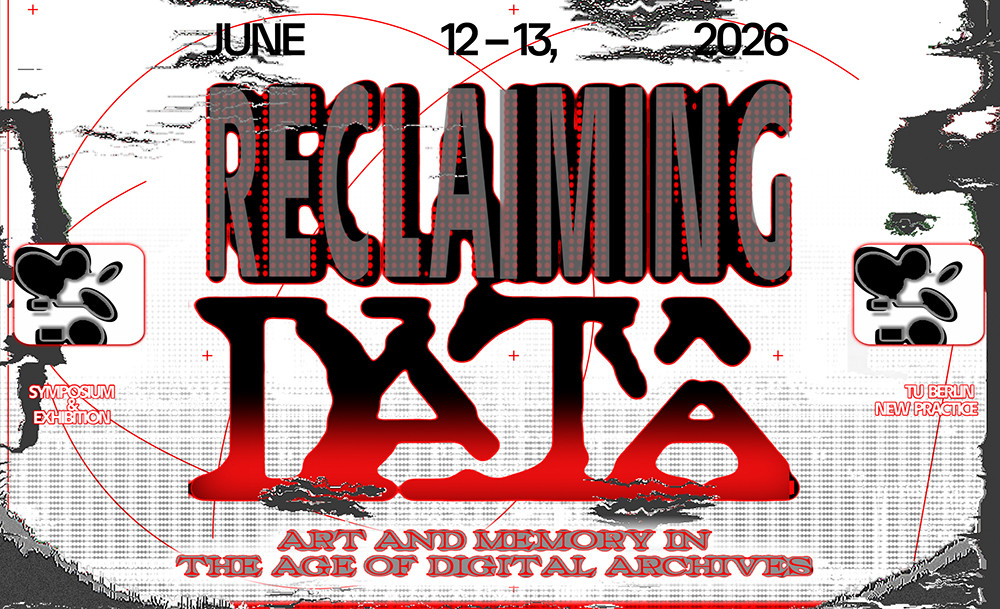
Reclaiming Data is a symposium and exhibition that brings together artists, researchers, students, and cultural institutions to explore how artificial intelligence, digital archives, and data infrastructures are transforming collective memory. Across two days, the program moves between keynote, screening, workshops, panel discussions, performance, and exhibition, creating a space in which artistic, theoretical, and institutional perspectives can meet.
The symposium asks: How do digital archives shape the ways we remember? Who decides what remains visible, what gets rewritten, and what disappears? And what happens when generative systems begin to reorganise the past through datasets, statistical models, and platform infrastructures?
At its core, Reclaiming Data begins from the observation that today’s archives are no longer only institutions of preservation but increasingly operational systems: they sort, model, predict, and generate. In this sense, generative systems can be understood as inherently “nostalgic” technology. Trained on past data, they reconstruct patterns and produce synthetic versions of history. The project asks how these infrastructures shape historical consciousness, and how artistic and critical practices might intervene in them.
The symposium unfolds across three thematic trajectories. The first addresses the biases, exclusions, and political asymmetries embedded in datasets and platform systems. The second focuses on artistic and activist practices of reappropriation – from reverse archaeology to synthetic historicity. The third opens toward questions of commons, institutional responsibility, and community-oriented forms of archiving, asking how critical perspectives can be translated into concrete practice.
Alongside the symposium, the exhibition at UNIversum extends these questions into space. Bringing together artistic positions by Nora Al-Badri, Juan Covelli, Egor Kraft, Yagmur Uckunkaya / Artur Cipriani, and a live performance by Jiawen Wang, the exhibition explores archives not as neutral repositories, but as contested and constantly shifting terrains of memory.
The symposium opens on Friday, 12 June, with a keynote by Roland Meyer, whose work on networked image cultures and generative image worlds sets the discursive frame for the event. This is followed by a screening of Afterlives by Kevin B. Lee, and an aftertalk with Orit Halpern, opening questions of historicity, mediation, and synthetic image culture.
On Saturday, 13 June, the day begins with three parallel workshops by Michael von zur Mühlen, Allapopp, and !Mediengruppe Bitnik, each approaching datasets, memory-making, and digital infrastructures through different practical methods.
In the afternoon, two panels bring together artistic and institutional perspectives. Panel 1 focuses on artistic forms of reappropriating digital infrastructures of the past, featuring Nora Al-Badri, Juan Covelli, and Egor Kraft. Panel 2 turns toward commons, community archives, and institutional practice, with invited participants from HKW, Staatsbibliothek zu Berlin, and Trust Support. The symposium closes with the roundtable “Where do we go from here?”, a reflection format that aims to translate the discussions into possible next steps, alliances, and practical perspectives.
Most symposium formats are open to the public.
Workshops require prior registration due to limited capacity.
Reclaiming Data explores how digital archives, datasets, and artificial intelligence shape what we remember — and what may disappear. In a world deeply structured by digital systems, the project asks which voices remain visible, what gets overwritten, and which stories need to be retold so they are not lost.
The exhibition translates these questions into six artistic works. It shows that archives are not neutral repositories, but places where history, power, images, technology, and memory are constantly being renegotiated. No specialist knowledge is needed — these are questions that affect all of us: How are images of the past produced in the age of digital archives?
Symposium: 12–13 June 2026
Exhibition: 12–14 & 18–21 June 2026
(New) venue: Flutgraben e.V. / Am Flutgraben 3 / 12435 Berlin
Free admission
Programme
Friday, 12 June 2026
5:00 pm – Exhibition opening
Nora Al-Badri, Juan Covelli, Egor Kraft, Yağmur Uçkunkaya & Artur Cipriani, Minne Atairu, Nouf Aljowaysir
6:00–7:15 pm – Keynote: Roland Meyer
7:30–9:00 pm – Screening: Afterlives by Kevin B. Lee
9:00–10:00 pm – Conversation with Kevin B. Lee and Orit Halpern
Saturday, 13 June 2026
10:00–11:30 am – Workshops (see below)
with Michael von zur Mühlen, allapopp, and !Mediengruppe Bitnik
12:00–1:30 pm – Panel 1
On Reverse Archaeology and Synthetic Historicity
with Nora Al-Badri, Juan Covelli, and Egor Kraft — moderated by Jonny-Bix Bongers
2:30–4:00 pm – Panel 2
On Commons, Community Archives & Institutional Practice
with Sara Morais dos Santos Bruss (HKW), Clemens Neudecker (Staatsbibliothek), Lina Martin-Chan (Trust Support) — moderated by Anna Kraher
4:30–6:00 pm – Roundtable with Vinzenz Aubry
7:00 pm – Live performance by Jiawen Wang
You can find more information about the full programme here:
koerber-stiftung.de/projekte/ecommemoration/reclaiming-data
/
For the skill-sharing workshops (held in English), registration via Eventbrite is required due to limited capacity:
Workshop 1:
Samstag, 13. Juni • 10:00 - 11:30
“Memory Machines — LLMs, archival silence, and the politics of historical voice”
A Reclaiming Data Skill Sharing Session with Michael von zur Mühlen
eventbrite.de/e/1989643198366
This workshop introduces Will the Revolution Not Be AI Scripted?, an interactive art installation in development that stages an encounter with AI-mediated voices of resistance — drawn from labor movements, anti-colonial struggles, and subaltern histories. The project is built on archival material from European and South Asian collections, including sources whose gaps and silences are themselves the product of colonial archival practice.
AI systems are predominantly developed to optimize workflows, drive economic growth, and enable targeted marketing, military operations, and surveillance. This workshop asks what an emancipatory — perhaps even subversive — use of these same technologies might look like. Not AI as a self-optimization tool, but AI as a space for politicizing individual experience and embedding it within a heterogeneous memory of past and present social struggles.
Working with the actual technical stack of the project — large language models, retrieval-augmented generation pipelines, and self-curated archival datasets — participants explore how institutional knowledge gaps, training data politics, and LLM hallucination become artistic material rather than engineering problems. A central practical question is how to work with large, heterogeneous, self-assembled collections: how to structure, embed, and query material that was never designed to be machine-readable, and how the shape of that data — its inconsistencies, its silences, its uneven coverage — becomes legible in the behavior of the system.
The workshop takes Saidiya Hartman's Critical Fabulation and Michel-Rolph Trouillot's Silencing the Past as methodological anchors: archival absence is treated not as a failure to be corrected but as a political statement about whose voices were excluded from the record. The central question is not how to make AI speak more accurately about the past, but how to design systems in which the limits of that speech remain visible — and what it means to build memory infrastructure on top of technologies produced through their own forms of invisible labor.
Workshop 2:
Saturday, June 13 • 10 AM - 11:30 AM
“AI Sound and Cultural Memory — From Dataset to Performance”
A Reclaiming Data Skill Sharing Session with allapopp
eventbrite.de/e/1989658541257
This 1.5-hour Skill Sharing Session with allapopp offers insight into an artistic workflow — from critical model conceptualization and data collection to its transformation into sound and live performance. Focusing on current research with small datasets and non-dominant cultural narratives, the workshop explores low-barrier approaches to AI sound (style-transfer) model training. Using an accessible, off-the-shelf sound plugin, participants will be able to follow how small, situated datasets can be used within a style-transfer model.
Grounded in the ongoing project Virtual Tatar Choir, which asks Why is there no Tatar Science Fiction?, the session draws from personal and archival recordings of rural Tatar singing. It reflects on how AI systems — often shaped by dominant Western datasets — interact with marginalized cultural material.
Through practical examples and discussion, the workshop opens questions around authorship, bias, and the political dimensions of datasets, inviting participants to approach small datasets as a deliberate artistic and cultural strategy.
Workshop 3:
Saturday, June 13 • 10 AM - 11:30 AM
“Unreal Data — Real Effects”
A Reclaiming Data Skill Sharing Session with !Mediengruppe Bitnik
eventbrite.de/e/1989658999628
!Mediengruppe Bitnik are contemporary artists who work on and with the Internet. Their practice expands from the digital to affect physical spaces, often intentionally employing loss of control to challenge established structures and mechanisms. Their works are shown internationally, most recently in exhibitions at Kunsthalle Osnabrück, the 9th Trondheim Biennale for Art and Technology, and Aksioma Institute for Contemporary Art Ljubljana.
Data has become the raw material of social environments, and automated data collection is an intrinsic component of most technological systems and devices. Our interactions with technology generate data that in turn influences our world: our devices tell us how well we have slept, predict where our favourite restaurants will be, and what products we will like. Data shape our news feeds, determine which borders we are allowed to cross, and the jobs we can successfully apply for.
This workshop offers a critical and performative approach to digital rating practices and looks specifically at how online reviews shape our perception of place. We explore the history, impact, and political dimension of systems that rate geographical place — from the first travel guides of the 19th century to today's data-driven platforms like Google Maps. We examine the materiality of this data, its specific textures and aesthetics. As part of the workshop, participants will install a browser extension that only displays 1-star reviews — a shift in perspective that reveals everyday life through the lens of the disappointment of others.
Please bring a laptop.
Partner
Reclaiming Data is a collaboration by DOCKdigital, New Practice / Design & Computation, and Körber-Stiftungs’ eCommemoration programme, supported by Technologiestiftung Berlin and Burg Hülshoff – Center for Literature, curated by Jonny-Bix Bongers.