

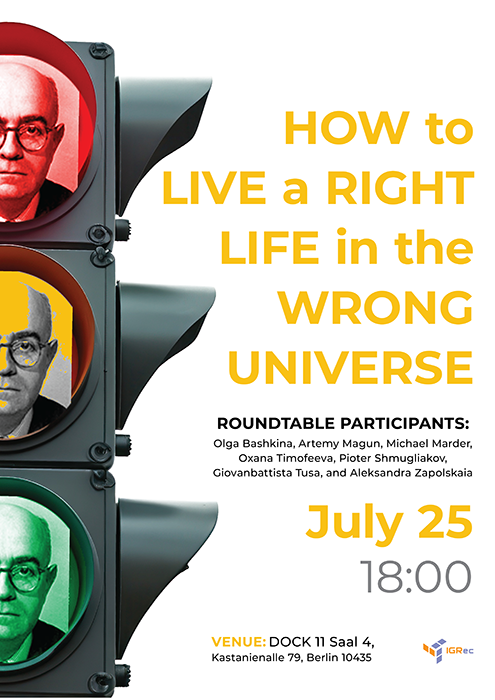
Date:
Saturday, 25 July 2026
6 PM
Place:
DOCKdigital
DOCK 11, Saal 4
Kastanienallee 79, 10435 Berlin.
Roundtable
Participants: Olga Bashkina, Artemy Magun, Michael Marder, Oxana Timofeeva, Pioter Shmugliakov, Giovanbattista Tusa, and Aleksandra Zapolskaia.
Free admission; no registration required.
More information: Institute for Global Reconstitution IGRec igrec.io
Institute for Global Reconstitution is inviting you to a roundtable discussion “How to Live a Right Life in the Wrong Universe“.
Our historical moment does not appear particularly conducive to ethical reflection. On the one hand, the illiberal side of contemporary political conflicts is often driven by cynicism and a spirit of resentment rather than by any aspiration to moral truth. Political polarisation fosters a friend–enemy logic that is either non-ethical or only dubiously ethical, where, to paraphrase Marx, it becomes less important to convince one's opponent than to strike a blow against them. On the other hand, the individual perspective and sense of personal responsibility—both indispensable to ethical thinking—have also receded in an age marked by identity claims and increasing pressures towards standardisation. This stands in sharp contrast to the flourishing of ethical philosophy during the 1990s and early 2000s.
Nevertheless, philosophers associated with the Institute for Global Reconstitution maintain that ethics, as distinct from morality, deserves renewed attention, not least because the current polycrisis possesses a profound ethical dimension. The present polarisation itself has ethical roots: the liberal "beautiful soul" is increasingly confronted by a combination of moral traditionalism and overt cynicism, as exemplified by the political leaderships of Russia and the United States. At the same time, this confrontation places the subject in the fundamentally unethical position of mortal combat. Likewise, existing universalist projects—whether environmentalist, socialist, or anti-colonial—are driven by scientific and political imperatives. Yet their repeated inability to achieve their stated aims often transforms them into individual moral commitments, bringing with them a distinct set of philosophical problems.
Against this background, the roundtable will address the following questions:
- Can there be an ethical standpoint that constitutes a genuine alternative to morality?
- Is there today a meaningful form of ethical perseverance that does not collapse into fanaticism?
- How should we rethink the relationship between the ethics of the self (Foucault, Badiou) and the ethics of the Other (Levinas, Sartre, Critchley)?
- Are psychoanalytic responses to the moral crisis still tenable in the age of "therapeutic culture", when the subject inevitably oscillates between transgression and melancholia?
These and related questions will be discussed at the invitation of the Institute for Global Reconstitution (IGReC) by Olga Bashkina, Artemy Magun, Michael Marder, Oxana Timofeeva, Pioter Shmugliakov, Giovanbattista Tusa, and Aleksandra Zapolskaia.
The roundtable will be followed by a reception.
supported by: DOCK 11 / DOCKdigital